
Silicon carbide heating elements are tubular or rod-shaped non-metallic electric heating elements. They are made from high-purity green silicon carbide as the main raw material, processed through blank forming, high-temperature silicification, and recrystallization, with advantages of high-temperature resistance, oxidation resistance, and average heat distribution.
If you are finding heating elements for high-temperature operating conditions, you are likely familiar with them. Different structures are designed for different working environment. This article will introduce 6 common types of silicon carbide heating elements. Through their characteristics and applications, you will find the type that that match your industrial requirements.
GD-Type Silicon Carbide Heating Elements
GD-type SiC heating element is one of the most common and basic type. It features a rod-shaped structure with a central heating section and conductive cold ends at both ends. Typically fabricated by welding three sections (one heating section and two cold ends) together. This type is easy to install and affordable, offering a long service life with low maintenance costs.

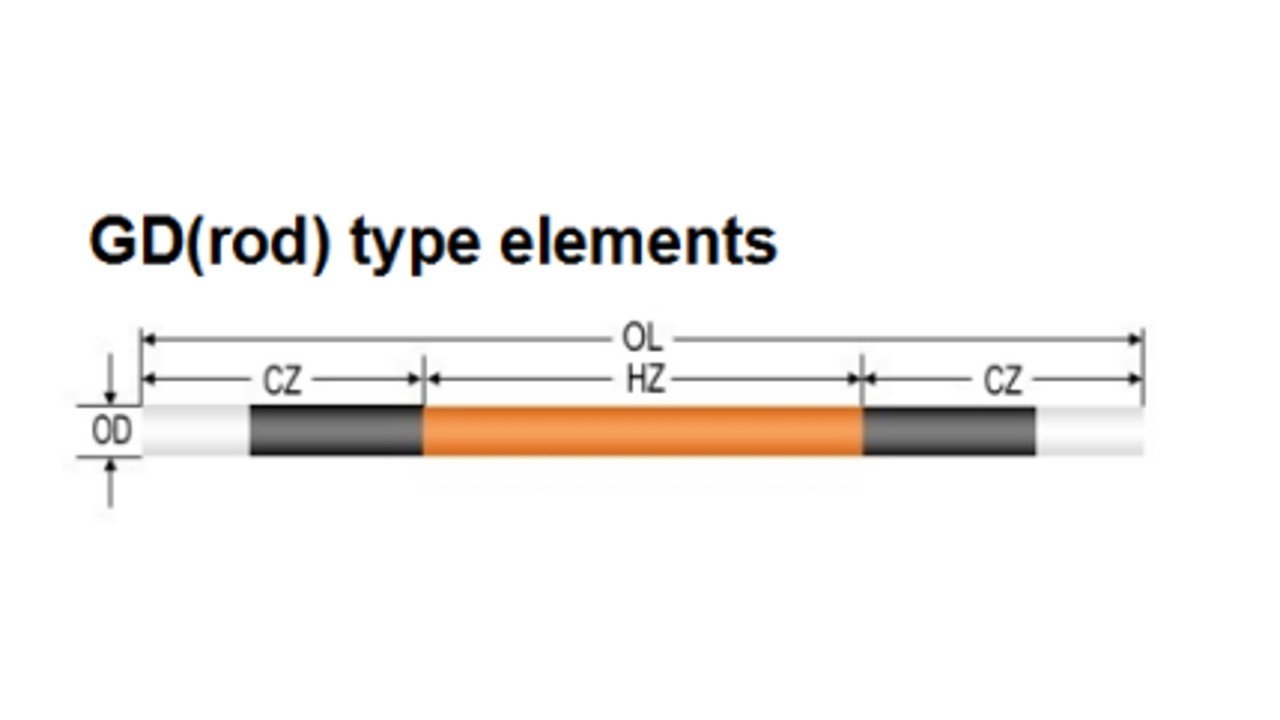 GD-Type SiC Heating Elements
GD-type elements are widely used in various industries. For small production lines with low heating space requirements, these elements can fully meet your requirements. They can provide stable temperatures from 400℃ to 1400℃, particularly suitable for low-temperature preheating of ceramic materials and the annealing of glass products.
When selecting GD-type elements, ensure the rod length matches the furnace dimensions to avoid cold spots.
GDU-Type Silicon Carbide Heating Elements
GDU-type SiC heating element is composed of two heating sections of equal radius sharing a single cold end (bridge section), forming a “U” shape. Compared to two independent GD-type elements, the GDU-type has only 2 cold ends, which reduce energy consumption by 10-20%, improving heating efficiency. Moreover, installation is simplified as wiring is only required at one end.

 GDU-Type SiC Heating Elements
If you are concerned about furnace space, this is a preferred solution. It is commonly used in industrial ceramic sintering kilns and high-temperature sintering furnaces for electronic components, achieving high-temperature outputs of 1000-1600℃. Many ceramic processing factories use them to replace multiple GD rods to reduce the number of installation holes and simplify furnace sealing.
SC-Type Silicon Carbide Heating Elements
SC-type SiC heating element is a single-spiral element where a spiral groove is cut into the surface of the heating section. The spiral structure increases effective length of the heating element and its electrical resistance, suitable for demanding high-temperature and corrosive conditions. This design also makes SC-type more durable under harsh environment compared to the GD-type.

 SC-Type SiC Heating Elements
SC-type silicon carbide heating elements are mainly employed in kilns and furnaces that require high operating temperatures up to 1600℃. They are applied in industries with severe environment or oxidative and corrosive gases. Typical applications include the aluminum industry, die casting, as well as various high-temperature testing equipment and laboratory furnaces.
SCR-Type Silicon Carbide Heating Elements
SCR-type SiC heating element features a double spiral groove cut into the surface of the heating section. It achieves precise temperature control and faster heating rates. SCR-type elements can withstand high temperature of 1650℃ while maintaining stable thermal output. With wiring required at only one end, its installation is significantly more convenient.

 SCR-Type SiC Heating Elements
If your industries have extremely stringent temperature accuracy requirements, the double spiral SiC rod is ideal. It is suitable for the high-temperature sintering of specialty ceramic materials and laboratory equipment that require precise temperature control, preventing cracking and deformation of the ceramic green body effectively.
However, due to its high manufacturing cost, its use should be determined with the value and requirements of your product.
W-Type Silicon Carbide Heating Elements
W-type SiC heating element combines three single-phase elements to create a “W” shape, designed with a longer heating length and a smaller heat dissipation surface area. Its folded structure significantly increases power density, while a high-quality, dense ceramic coating enhances oxidation resistance, allowing continuous working in high-temperature applications.

 W-Type SiC Heating Elements
When operating temperatures exceed 1600℃, W-type element still excels. It is specifically designed for three-phase power supplies, typically applied in the tin bath heating of the float glass industry.
W-type elements require high installation precision. We recommend you to use specialized fixtures to secure them, preventing deformation under high-temperature conditions.
DB-Type Silicon Carbide Heating Elements
DB-type SiC heating element features cold ends larger than those of the heating section, resembling a dumbbell. Such a design ensures lower electrical resistance at the cold ends, helping reduce operating temperature, minimizing the thermal damage to the furnace body. DB-type can concentrate heat in the furnace chamber, preventing heat loss through the cold ends to the external environment.

 DB-Type SiC Heating Elements
DB-type is perfect for industries that need high thermal efficiency as well as reduced heat loss. It applies to the same industries as the GD-type, such as electronics, magnetic materials, powder metallurgy, and precision casting, frequently used in pusher kilns, mesh belt furnaces, and box furnaces. In certain furnace designs where excessive cold-end temperatures might damage the refractories and insulation materials, the DB-type effectively solves this issue.
Selecting SiC Heating Elements: Matching Your Needs for Higher Efficiency
After reviewing the types, are you clearer about which direction to follow to select the right silicon carbide heating element? As a core of heating elements for ceramic materials, SiC rod type directly impacts production efficiency and the quality of products. You should consider the requirements of the electric furnace’s structural dimensions, total power requirements, furnace temperature, and temperature field distribution.
If you are still unsure which type is the best for your specific operating environment, please contact Newthink New Materials and tell us about your requirements. With over 14 years of industry experience, Newthink can help you precisely recommend the silicon carbide heating elements that perfectly match your industrial needs.
Thank you for reading. Hope this article will be helpful.
FAQs
- What is the difference between black and green silicon carbide?
Green SiC is made from high-purity raw materials. It has better purity and electrical properties than the black one, ideal for high-quality heating elements.
- What is the maximum temperature for silicon carbide heating elements?
Standard types handle up to 1400℃. Specialized types like SC and W-types can reach 1600℃. The SCR-type can withstand up to 1650℃.
- What dissolves silicon carbide?
SiC is highly acid-resistant but can be dissolved by molten alkalis or attacked by basic slags and certain molten metals at extreme temperatures.
- Is SiC a good thermal conductor?
Yes. It is known for high thermal conductivity and average heat distribution. Silicon carbide products can ensure stable temperature with high efficiency.
Reference
[3] Ruys, A. J. (2023). Silicon carbide ceramics: structure, properties and manufacturing. Elsevier.


