
It is not easy to choose a ceramic material for a specific industry. Each ceramic has unique property for certain uses. Some ceramics are ideal for high-temperature uses; others are perfect for highly corrosive environment. Learning properties of different ceramic materials can help you choose the suitable one for your industry. This article will provide a comprehensive guide from the categories and key properties of ceramics to how to choose among various ceramic materials.
Common Types of Ceramic Materials
Not all ceramics possess the same properties. Below are 4 categories of ceramic materials and their core properties you may want to know.
Silicate ceramics
Silicate ceramics are made of natural raw materials, such as clay and quartz. Silicates are durable, and can be easily shaped to various appearances. Because their raw materials are easy to get, the price of silicates is also cheap.
Glass ceramics
Glass ceramic materials are the results of the controlled crystallization of a glass. They possess high strength, good chemical durability and electrical insulation.
Oxide ceramics
Oxide ceramics is inorganic compounds composed of oxygen with other elements, such as zirconia and alumina. They are stable under harsh environment, with chemical inertness and high melting points. Oxides are commonly used in applications in harsh environment.
Non-Oxide Ceramics
Nitride ceramics, such as silicon nitride, and carbide ceramics like silicon carbide, are both non-oxides. These materials tend to be very hard and strong, along with high thermal conductivity and good electrical insulation properties.

 Silicon Carbide Ceramic Production Workshop
Select Ceramic Materials based on Industrial Applications
To help you identify the most suitable ceramic, the natural advantages of each can be aligned with the operating environment. Below are the targeted recommendations.
Household Items and Architectural Decor
When it comes to domestic and decorative applications, Silicate Ceramics is the preferred option because it is flexible and affordable. The fact that the raw materials, clay, are readily available makes them a low-cost option despite being durable. For applications that require a combination of heat shock resistance and aesthetic qualities, Glass Ceramics qualify to be the best choice.
High-Temperature Applications
In metallurgy and in chemical processing, Oxide Ceramics such as Alumina and Zirconia are the reference materials. This is because of their resistance to high temperature and corrosion, which does not allow any reaction of the molten metal or the highly reactive chemicals.
Alumina ceramic boats, with their high cost-effectiveness and high mechanical strength, have found their application as a carrier in the temperature range from 1600℃ to 1700℃. Alumina ceramic boats have been widely applied in tube furnaces as carriers for powder calcination, atmosphere sintering, as well as other chemical processes of various non-metallic materials.

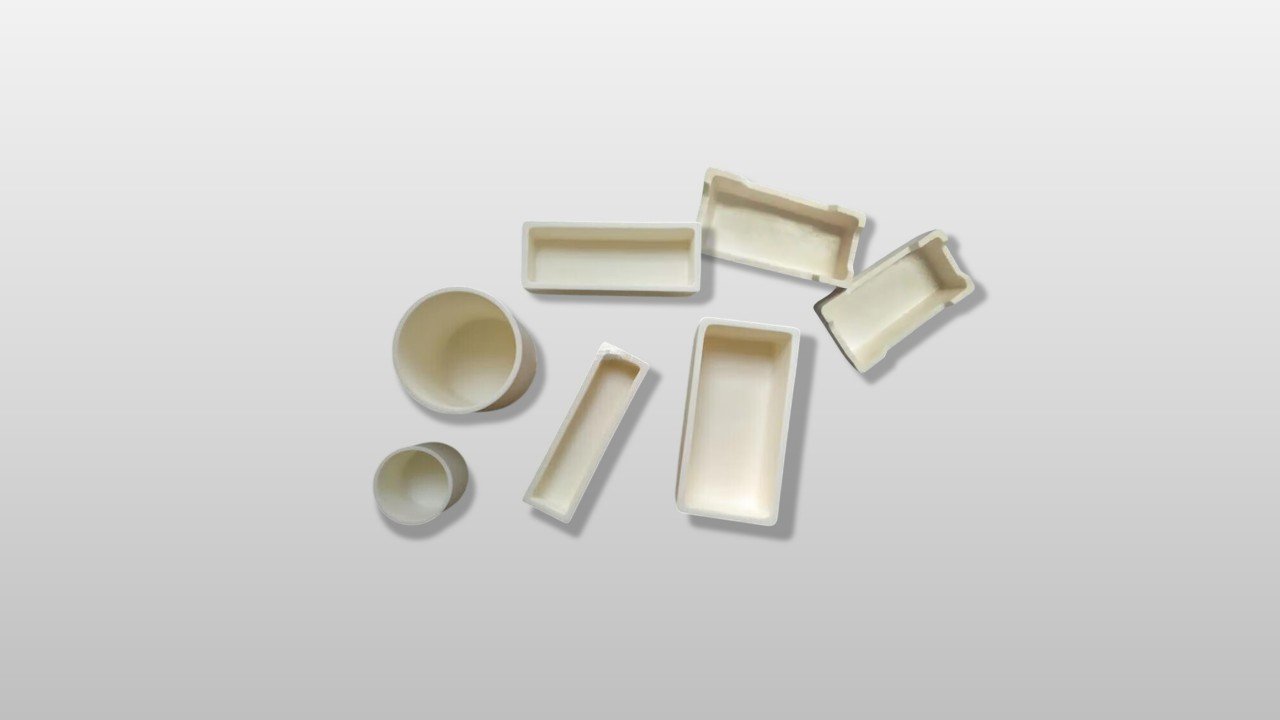 NKM Alumina Ceramic Boats and Crucibles
High-Wear Machinery and Tools
In machinery and tools industry with high wear, there are two ceramics that top the list: silicon carbide and silicon nitride. Possessing extremely high hardness, they are suitable for environment under high friction and high mechanical stress. Moreover, their thermal conductivity is very high, which is important in high-speed machining.
Silicon carbide cutting tools make a great contribution in enhancing the precision of manufacturing due to their high speed and high hardness. Silicon carbide seals are the leaders in offering long-term protection for stable and smooth functioning by providing better corrosion protection, wear resistance, and heat transfer.

 Silicon Carbide Machining Tools (Cutting Tools, Bearings, Bushings, etc.)
Electronics and Semiconductor Manufacturing
This sector largely relies on materials that possess high electrical insulation. Boron nitride and silicon carbide can be used. Both of them impart cooling properties along with electrical insulation.
Many processing steps in semiconductor manufacturing are also carried out at high temperatures. Silicon carbide ceramics with high thermal strength and dimensional stability are common in parts for carrying and supporting wafers, such as chucks, boats, and end effectors. Silicon carbide ceramics deform less at high temperatures than alumina ones, maintaining the flatness of wafers.

 Drawings of NKM Silicon Carbide Chucks
Defense and Military Protection
Military protection requires less prioritization of strength as compared to aeronautical applications. However, there is more focus on impact resistance. Boron carbide and silicon carbide can be found in military protection, because they can sustain intense pressure, though they are lighter than several metallic alloys.
Silicon carbide bulletproof plates rely on their high compression strength and hardness, which ceramics possess, to protect against high-speed bullets. They also work well against various armor-piercing rounds. For defense, SiC armor is ideal for balancing safety, mobility, and cost-effectiveness.

 Silicon Carbide Armor Plate Production
How to Choose the Right Ceramic Material for Your Industry?
Define your industrial environment. Mapping out the conditions that your material will face. What temperatures will it be exposed to? Will it contact with corrosive chemicals? What mechanical stresses will it endure? Answering these questions to narrow your options.
Prioritize required properties. Do you need maximum hardness? Is electrical insulation the top priority? Ranking the properties will help you compare materials effectively.
You’d better consider several critical physical and chemical properties. If you are not clear about the specific performance of different ceramics materials, here is a table showing the properties of common ceramic materials.
| Material | Alumina (Al₂O₃) | Zirconia (ZrO2) | Silicon Nitride (Si3N4) | Aluminum Nitride (AlN) | Silicon Carbide (SiC) | Boron Nitride(BN) |
| Density (g/cm3) | 3.85 – 3.92 | 5.98 – 6.08 | 3.20 – 3.26 | 3.26 – 3.33 | 3.10 – 3.22 | 2.00 – 2.30 |
| Vickers Hardness (HV) | 1400 – 1800 | 1050 – 1350 | 1490 – 1550 | 1100 -1200 | 2800 | 30-50 |
| Flexural Strength (MPa) | 27 – 33 | 800 – 1500 | 600 – 1200 | 300 – 400 | 350 – 500 | 20 – 60 |
| Fracture Toughness (MPa·m1/2) | 330 – 500 | 6.0 – 12.5 | 5.0 – 8.0 | ~3.0 | 4.0 – 5.35 | – |
| Elastic Modulus (GPa) | 2000 – 2950 | 200 – 220 | 290 – 320 | 300 – 320 | 400 – 420 | – |
| Thermal Conductivity (W/m·K) | 4 – 5 | 2.0 – 3.0 | 15 – 130 | 90 – 230 | 25 – 150 | 33 – 50 |
| Coefficient of Thermal Expansion (10-6/K) | 1650 – 1750 | 9.6 – 11.2 | 2.6 – 3.6 | 4.0 – 4.6 | 4.0 – 5.2 | 1.5 – 2.0 |
| Maximum Service Temperature (℃) | 7.6 – 8.2 | 750 – 1000 | 1000 – 1300 | 1700 | 1400 – 1700 | 900 (in air) 2200 (inert) |
Compare materials. Use the table above or the information you received to evaluate each ceramic against your priority list.
Consider total cost of ownership. Don’t just look at the initial material price. Pay more attention to long-term value. A more expensive ceramic may last longer and reduce maintenance costs.
Check industry standards and specifications. Ensure the material meets your industry’s regulatory requirements. This is especially important for industries like aerospace, defense, or medical devices.
Conclusion
When selecting the best ceramic material, you have to weigh your performance requirements against your financial budget. Knowing the varying characteristics of ceramic materials allows you to maximize your industrial operations when utilizing these materials.
In case you are still confused about the type of ceramic material to pick, you should reach out to the manufacturers of advanced ceramic materials, such as Newthink New Materials. Since NKM possesses over 14 years of experience in this industry, we are able to provide assistance in determining the ceramic material that would be most apt for your industry.
Thanks for reading this article. Hope it will be helpful to you.
FAQs
- Whichis the most common ceramic material?
Silicates are the most common seen ceramic in daily life, because of their use in architecture and household items. In industry, alumina ceramics are one of the most widely used ceramics for its cost-effectiveness.
- What is the most durable ceramic material?
Silicon carbide and silicon nitride are durable in terms of hardness and wear resistance. For chemical durability, glass ceramics and oxides are often preferred.
- Which ceramic is best for extreme heat?
Oxide ceramics like alumina and zirconia are generally preferred for high-temperature furnace linings.
- Are silicate ceramics expensive?
No. They are typically cheap because their raw materials are easily accessible.
- What are non-oxide ceramics used for?
They are used in high-performance applications, such as rocket nozzles and industrial cutting tools due to their extremely high hardness.
- What is the best material for ceramics?
There is not the best material, only the materials best suited for your application. For high heat, oxide ceramics like alumina are best. For hardness, non-oxide ceramics like silicon carbide are superior.
- What material is better, porcelain or ceramic?
Porcelain is a type of silicate ceramic. It is generally more refined and durable for household use. For industrial applications, engineering ceramics like mullite or advanced ceramics like silicon carbide offer better performance.
Reference
[1] Brook, R. J. (Ed.). (2012). Concise encyclopedia of advanced ceramic materials. Elsevier.
[2] Buchanan, R. C. (Ed.). (2018). Ceramic materials for electronics. CRC press.


 English
  Spanish
  Portuguese
  German
  Arabic
