
High-temperature processes need to use robust furnace tubes to maintain consistent conditions. Silicon carbide and alumina are the two most popular high-temperature furnace tube materials. They provide various advantages for high-temperature industries.
However, if you choose one that is not suitable for your conditions, it will lead to failure. It can even cause downtime and higher costs. This article shows a comparison of these two materials. We will focus on practical performance that directly impacts your production.
Brief Overview of Silicon Carbide & Alumina
Before the comparison, it will be helpful to understand their materials. Their properties determine how each tube will perform under specific conditions.
What are Silicon Carbide (SiC) Furnace Tubes?
SiC is popular for excellent thermal conductivity, hardness, and thermal shock resistance.[3]
Most industrial SiC furnace tubes use recrystallized (RSiC) or reaction-bonded (RBSiC). RSiC offers the highest temperature rating and purity. It is the standard for heavy industrial use.

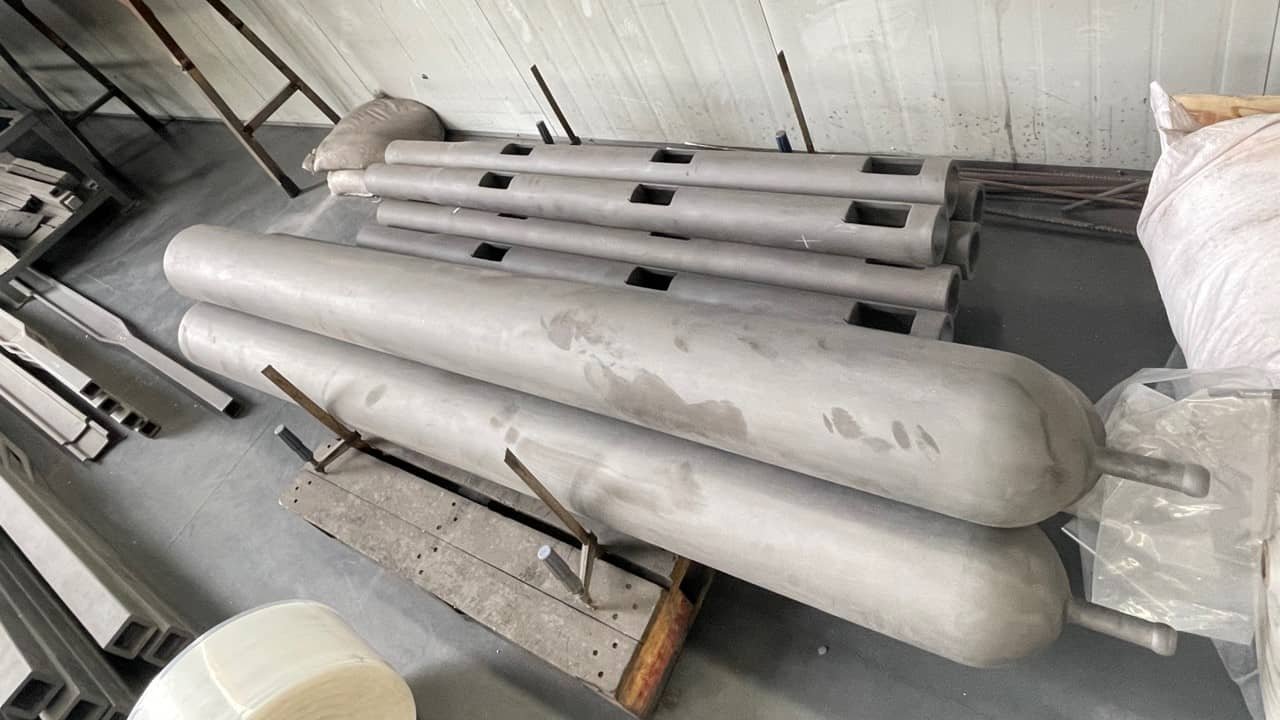 Silicon Carbide Furnace Tubes
What are Alumina (Al2O3) Furnace Tubes?
Alumina tubes are made from high-purity aluminum oxide, typically 99% and higher. A dense corundum crystal structure gives them excellent high-temperature stability and electrical insulation. It is one of the most widely produced engineering ceramics, with a long track record in furnace applications.[2]

 Alumina Corundum Furnace Tubes
Performance Comparison: Silicon Carbide vs Alumina Furnace Tubes
Below, we compare their key metrics that affect your process quality, maintenance frequency, and energy bills.
Highest Continuous Operating Temperature
Recrystallized silicon carbide tubes support continuous operation at up to 1,650℃ (3,002℉). Lower-grade SiC formulations, like RBSiC, have lower temperature limits around 1,450℃.
High-purity 99.5% Alumina tubes handle continuous temperatures up to 1,600℃ (2,912℉).
For short peak temperature cycles, both materials can tolerate roughly 100℃ above their continuous ratings.
Heating Efficiency
Silicon carbide has roughly 6~8 times higher thermal conductivity than Alumina at operating temperatures. This means SiC tubes heat up faster, create more uniform temperature zones, and reduce your overall energy use.
Alumina is less conductive and, therefore, can be beneficial if you require slow and controllable heating.
Thermal Shock Resistance
Silicon carbide possesses a much lower thermal expansion rate and higher conductivity than Alumina. This makes SiC much more resistant to damage caused by quick heat changes.
Since alumina tubes are easily crackable during sudden changes in temperature, slower ramping rates are needed. In batch manufacturing where the furnace is often turned on and off, SiC tubes have a longer lifespan.[3]
Chemical Resistance
Silicon carbide performs well in acidic environments and against most non-ferrous molten metals. It forms a protective silica layer in oxidizing conditions, but alkali metals can break it down over time.
Alumina offers better resistance to alkaline environments and strong reducing atmospheres, like hydrogen. It is also more stable in contact with alkali metal salts and vapors at high temperatures.
Both materials cannot hold up well against hydrofluoric acid or hot concentrated phosphoric acid.
Mechanical Strength & Wear Resistance
Silicon carbide ranks 9.5 on the Mohs hardness scale and is one of the hardest engineering ceramics available. Even at extreme operating temperatures, it still possesses most of its strength. For processes with abrasive material flow, SiC tubes offer longer service life.
Alumina has a Mohs hardness of 9, which is still very hard, but softer than SiC. It also loses strength more quickly as temperatures rise above 1,400℃.
Electrical Insulation Properties
Electrical properties are a critical factor for furnaces with internal heating elements. Alumina is an excellent electrical insulator, even at very high temperatures. This makes it the standard choice for tube furnaces with built-in resistance heating elements. Silicon carbide is a semiconductor material and will conduct electricity at elevated temperatures. You cannot use SiC tubes in applications where the tube must provide electrical isolation.
Cost & Lifespan
On average, you can expect to pay 40~60% less for a high-purity alumina tube than an equivalent SiC tube. It works well for lower-usage scenarios where replacement costs are less impactful to your budget.
SiC tubes carry a higher price due to more complex manufacturing and raw material costs. But in the right operating conditions, SiC furnace tubes last 2~3 times longer than alumina ones. They also cause fewer shutdowns from unexpected failure.[1] For continuous production lines, SiC often has a lower total cost of ownership.
Ideal Applications for SiC & Alumina Furnace Tubes
Performance only provides a baseline. You need to match the material to your exact process. Here is where each type delivers the strongest return on investment for common industrial use cases.
When to Choose Silicon Carbide Furnace Tubes?
If you run 24/7 production and want to minimize downtime, SiC is almost always the better choice. You will get the most value from SiC furnace tubes in these situations:
- Continuous high-temperature sintering lines for structural ceramics, powder metallurgy, or magnetic materials.
- Batch processes with frequent heating and cooling cycles that demand high thermal shock resistance.
- Operations involving abrasive material flow or fluidized-bed conditions that cause wear.
- Processes where energy efficiency and uniform temperature distribution are top priorities.
- Acidic atmosphere processes or molten non-ferrous metal handling.
When to Choose Alumina Furnace Tubes?
Operations with limited upfront budgets and lower utilization rates
- For labs and low-volume production, alumina delivers reliable performance at a much lower entry cost. They fit these situations:
- Laboratory furnaces and small-batch production systems with internal heating elements.
- Processes that run in strong reducing atmospheres, such as pure hydrogen.
- Applications requiring electrical insulation between heating elements and the work zone.
- Processes involving alkaline materials or alkali metal vapors.
FAQs
Which tube is better for high-temperature hydrogen atmosphere furnaces?
Alumina tubes. Silicon carbide can react with hydrogen at temperatures above 1,400℃, leading to gradual material degradation. High-purity alumina offers far better stability for long-term use in pure hydrogen.
How to extend the service life of my ceramic furnace tube?
- Follow recommended ramp rates to avoid thermal shock.
- Keep alkali metal contaminants and incompatible chemicals away from the tube surface.
- Perform regular visual inspections to catch small cracks.
Are there better ceramic tube materials than SiC and alumina?
If you are with extreme conditions, you can consider zirconia or boron nitride tubes. But they cost much more.
Can silicon carbide tubes be used in vacuum furnace applications?
Yes. SiC tubes work in vacuum furnaces up to approximately 1,600℃. Above that temperature, SiC may start to decompose in high-vacuum conditions.
What is the most common reason for furnace tube failure?
- Thermal shock from rapid temperature changes.
- Long-term exposure to alkali contaminants or overheating.
- Improper installation and physical impact during handling.[1]
How do I verify the quality and purity of a ceramic furnace tube?
For Alumina tubes, look for 99% minimum Al₂O₃ content for high-temperature use.
For SiC tubes, confirm the bonding type (e.g. recrystallized and reaction-bonded) and silicon carbide content.
Conclusion
Silicon carbide and Alumina both serve critical roles in high-temperature furnace operations. If you are still not sure which material fits, Newthink New Materials specialists can help. By reviewing your operating parameters, we can recommend the exact tube specification to maximize your uptime and efficiency.
Newthink also provides high-quality silicon carbide and alumina furnace tubes. Contact us for more information.
Thanks for your reading. Hope this article will be helpful.


 English
 Spanish
 Portuguese
 German
 Arabic

