
As one of the three legs of materials sciences, along with metals and polymers, ceramics provide support for modern industry and daily life. From daily necessities like tableware and tiles, to components in high-tech equipment, ceramic materials have found their way into almost all fields. This article helps you understand what ceramics are. The article will introduce their definition, characteristics and applications, giving you a deeper look at this important material.

 NKM Advanced Ceramic Production Workshop
What are Ceramics?
Ceramics refer to inorganic, non-metallic solids, in which inorganic compounds are the main constituents. It is not a single class but has further branches. Different ceramics differ much from each other in their choice of raw material, processes of preparation, characteristics in performance, and uses. They form the entire system of ceramic materials. A more detailed introduction will follow.
Basic Properties of Ceramic Materials
The excellent properties of ceramic materials make them irreplaceable in many fields.
Mechanical Properties
Ceramics possess excellent hardness, much superior to metals. They also show a high level of strength with great stiffness and resistance to deformation. The fracture toughness of ceramics like zirconia and silicon nitride is quite good, along with excellent impact resistance. In addition, compared with metals, ceramics are much more wear-resistant, providing great advantages in wear-prone conditions.
Physical Properties
Ceramics have excellent high-temperature resistance. With low coefficients of thermal expansion, their size changes with temperature increases or decreases are minimal, and they display excellent thermal stability. Ceramics will not crack upon rapid temperature change due to their high thermal shock resistance. In addition, most ceramics have a lower density than metals, lighter and more efficient in reducing equipment load. They are non-magnetic and not affected by magnetic fields. Some ceramics have good biocompatibility for implantation in the human body.
Chemical Properties
Ceramics possess a very high corrosion resistance. They may sustain even strong acids, alkalis and numerous organic solvents. In complicated chemical conditions at high temperatures, ceramics retain steady chemical performance and are less likely to react. This property further extends the service life in serious conditions, making it one of the finest materials for the chemical processing and metallurgical industries.
How are Ceramics Classified?
Ceramics can be categorized into traditional ceramics and advanced ceramics based on raw materials, manufacturing process and performance.
Traditional Ceramics
Traditional ceramics, also known as common ceramics, are made from natural minerals such as clays, quartz, and feldspar, and undergo the conventional processes of crushing, mixing, shaping, and firing. In the sintering process of traditional ceramics, the temperature is normally below 1300℃, while the product structure varies in density.
Their basic characteristics include hardness and corrosion resistance; however, they generally possess relatively low strength and toughness. In traditional applications, the use of traditional ceramic materials can be found in everyday household use and construction industries. These include household ceramics like cups, building ceramics such as floor tiles, sanitary ceramics such as sinks, and artistic ceramics such as vases and sculptures. These are the primary products associated with daily living.
Advanced Ceramics
Advanced ceramics, also known as engineering ceramics, are produced from high-purity, ultra-fine synthetic inorganic compounds such as alumina, zirconia and silicon carbide. They are fabricated by precisely controlling chemical composition with advanced manufacturing processes. The sintering temperature for advanced ceramics is usually higher than 1600℃, and the products possess a highly dense structure, a fine and uniform grain size, together with extremely low porosity.
Advanced ceramics not only possess all the basic advantages of traditional ceramics, but also exhibit superior properties like high-temperature resistance, wear resistance and enhanced durability. Some advanced ceramics have semiconductor properties. They are now widely used in high-tech fields including electronics, defense and aerospace. Common products include semiconductor device components, military armor and engine parts.

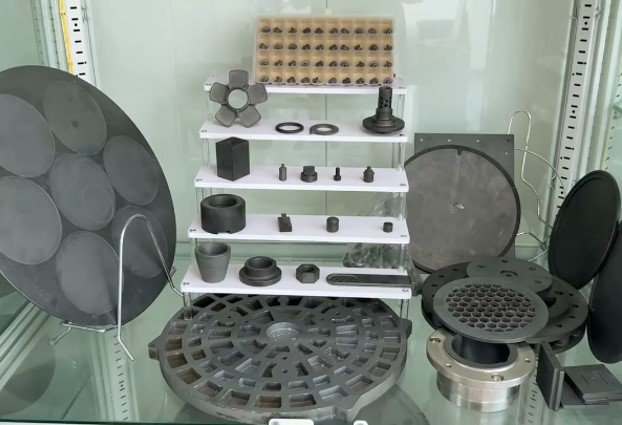 Silicon Carbide Advanced Ceramic Products
While traditional ceramics are developed mainly to meet the needs of everyday use and basic industrial requirements, advanced ceramics aim to solve technical problems in high-end industries. Both complement each other for further development and application of ceramic materials.
Advanced Applications of Ceramic Materials
With unique combination of properties, advanced ceramics play an irreplaceable role in modern industry and become key materials to drive industrial upgrades.
Silicon carbide and silicon nitride are core application materials in the high-temperature field. With high melting points and excellent stability, they are applied to fixtures like supports and rollers in industrial kilns. They provide ability to withstand cycles of heating and cooling at very high temperatures. Advanced ceramics find application in combustion nozzles and heat exchangers of big boilers in thermal power plants for the new energy sector. In aerospace, it is used in rocket nozzles, which greatly improve equipment operating temperatures and efficiency.

 NKM High-Temperature Silicon Carbide Roller Drawings
In semiconductor manufacturing, advanced ceramics are widely applied in parts and components, amounting to about 16% of the total value. High-purity alumina has the most mature application. Alumina electrostatic chuck is used to fix a wafer by electrostatic attraction in wafer processing. The flatness of this kind of chuck meets the requirements of the equipment. Meanwhile, the temperature control precision is very high. Alumina and silicon carbide ceramic arms are used in wafer transferring, high speeds without contamination in vacuum conditions. Besides, in etching machines and CVD equipment, it is common to use ceramic materials such as nozzles and liners to resist corrosion.

 NKM Silicon Carbide Arm
In the wear‑resistant field, alumina is the most widely used material for its excellent cost‑performance ratio. Silicon carbide serves in harsher working environment with its superior properties. In heavy industries like mining and cement production, ceramic-lined pipes exhibit more than five times the wear resistance of metal. Silicon carbide mechanical seals used in high‑speed pumps in the chemical industries are normally far more resistant to corrosion and wear than metal ones. In power plant desulfurization, silicon carbide nozzles also last much longer and thus provide notable economic benefits.

 Application of NKM Wear-Resistant Silicon Carbide Nozzles
Because of lightweight and high hardness, ceramics are a core material for modern protection systems in the defense industry. The highest hardness is offered by boron carbide. Silicon carbide strikes a good balance between performance and affordability. These materials are used for the production of stand-alone ballistic plates. They can also be combined with composite materials, which reliably protect soldiers and vehicles.

 NKM Silicon Carbide Bulletproof Plate
What Are the Advantages of Ceramics Compared to Metals and Plastics?
Compared with metals and plastics, ceramics are unique in terms of their adaptability to extreme environments and their balanced performance. Under extreme conditions such as high temperatures, strong corrosion, high wear and excellent insulation, both metals and plastics show conspicuous deficiencies. The demands can be met by ceramics, which fill the performance gap.
In terms of mechanical properties, ceramics are much harder and enjoy better wear resistance compared to metals and plastics. Metals have a medium hardness and general wear resistance, while plastics are soft and tend to wear easily. The wear resistance of ceramics is tens or even hundreds of times that of metals, offering better performance in cases of high abrasion.
In thermal properties, ceramics exhibit outstanding resistance to high temperatures, which neither metals nor plastics can provide. Metals soften and oxidize at high temperatures. Plastics have weak heat resistance, softening above 200℃. Ceramics do not lose shape or strength at temperatures exceeding thousands of degrees centigrade. Several may even resist an extreme temperature of up to 3000℃. In addition, its coefficient of thermal expansion is low with great thermal stability. It does not crack due to the sudden temperature change.
According to chemical properties, ceramics are highly resistant to corrosion, oxidation and super chemical stability. They will not deteriorate in strong acids, alkalis or harsh environments. Ceramics will neither rust nor age. But metals will deteriorate when exposed to acid and alkali corrosion. Plastics tend to age under UV light, ozone, and other environmental factors. Their lifespan is generally shorter. In comparison, ceramics keep performance stable even in complex environments.
The electrical properties make ceramics irreplaceable as insulators in high-temperature and high-frequency fields. The volume resistivity is high, with good dielectric strength. All metals are conductive and fail to meet the insulation requirements. Plastics, though insulators, will fail in high-temperature environments. Ceramics can well match the requirements of such high-power electronic devices.
Besides these special properties, ceramics offer advantages in general performance as well. Being less dense than metals, ceramics provide lighter equipment. Most ceramics are non-magnetic, which makes them suitable for use in special environments where magnetic interference must be avoided, such as in MRI machines. Those advantages further extend the application range of ceramics.
Common Questions
a) What is the difference between ceramics and pottery?
Ceramics is a broad term that encompasses both traditional ceramics and advanced ceramics. Pottery is a type of traditional ceramic.
Pottery is made of natural clay and fired at a low temperature of 800-1200℃ with simple processes. The product tends to have a loose structure with water absorption. Pottery is mainly used in everyday items like flower pots, bricks and jars. Pottery is a traditional member of the ceramic, whereas ceramics as a whole cover a much broader range. The latter includes not only traditional products like pottery, but also advanced ceramics with superior performance.
b) How are ceramics made?
The basic manufacturing process of ceramics includes the preparation of raw materials, forming, sintering, and post-processing.

 Advanced Ceramics Manufacturing Process
During the raw material preparation, a selection of natural minerals or high-purity synthetic powders is made according to the intended application.
Depending on the form and the precision needed, the forming involves traditional methods of throwing, slip casting, and pressing, or precision techniques such as dry pressing, isostatic pressing, and injection molding.
Sintering is the most important step. The ceramics must be heated to a specific temperature and in an appropriate atmosphere so that the particles may bond and can become densely compacted.
After sintering, some of the products are ready to ship after visual inspection. For those products that require high precision, other processes such as cutting, grinding, and polishing are performed. Performance testing is done to ensure the ceramic will meet quality standards.
Ceramic materials, with excellent performance, have become irreplaceable key materials that metals and plastic cannot substitute. Traditional ceramics meeting the needs of daily life and basic construction. Advanced ceramics supporting the development of high-tech fields. Ceramics are now important materials both in modern industry and everyday life. As materials science continues to develop, the performance of ceramics will always be optimized, and application scenarios will increasingly broaden, offering new momentum to industrial upgrading and technological development.
If you are looking for a reliable advanced ceramics supplier, please reach out to Newthink New Materials. NKM supplies many kinds of advanced ceramic products: silicon carbide, alumina, zirconia, and more. NKM can fully meet your industrial needs. Please visit website for more detailed information and request a free quote.


