
Industrial liners protect chutes, hoppers, pipes and mixing tanks from wear, corrosion and impact. They are the first defense line for processing equipment. The right liner material will effectively cut your maintenance costs and extend equipment life.
Steel, rubber, and silicon carbide are 3 widely used materials for liner in heavy industry. In this article, we focus on the performance, applications, cost benefits, and durability of these liners. You will learn how to pick the most cost-effective liner for your specific processing needs.
Overview of 3 Common Industrial Liner Materials
Different industrial liners adopt distinct manufacturing processes. They also possess different characteristics.
Steel Liner: Traditional Industrial Lining
Steel liners are the most common protection liner for industrial equipment made of mild steel or wear-resistant alloy steel. Possessing high mechanical strength and rigidity, they can easily resist heavy impacts and mechanical extrusion.
With excellent stability on the structure, steel liners do not deform easily under high-load mechanical pressure[4]. They also support simple processing and on-site installation. For decades, they have been the best choice for heavy machinery and mining equipment.

 Steel Cylinder Liner of the Diesel Engine
Rubber Liner: Flexible Lining
Industrial rubber liners use high-toughness natural rubber or synthetic rubber formulas. They have flexible buffer performance, which helps them absorb strong impact force and reduce equipment vibration. This can avoid rigid collision damage.[1]
Besides, they deliver basic corrosion resistance for weak acid and alkali environments.[3] Lightweight and quiet in operation, rubber liners are ideal for wear industrial conditions from low to medium.
Silicon Carbide Liner: High-Performance Lining
Silicon carbide (SiC) liners are advanced ceramic wear-resistant liners. They are sintered from high-purity silicon carbide raw materials, belonging to high-performance ceramic lining for harsh industrial conditions.
Silicon carbide ceramic liners have ultra-high hardness, far exceeding steel and rubber[4]. They feature excellent abrasion resistance, high-temperature stability and chemical inertness, and are the preferred upgrade solution for high-wear and corrosive industrial processing systems.

 Silicon Carbide Lining with Different Shape
Key Performance Comparison of Steel, Rubber and Silicon Carbide Liners
The performance varies to decide the uses of each liner in different circumstances. This is followed by a comparison between industrial indicators for you to know the strengths and weaknesses of these 3 liners.
Wear Resistance
Wear resistance is the most critical performance indicator for production continuity. It determines the replacement cycle of industrial liners.
- Steel linersoffer moderate wear resistance. They resist general friction but wear quickly under long-term fine particle scouring. Their service life is short in mining and slurry processing scenarios.
- Rubber linersperform well against impact wear. They buffer particle collision effectively. But they cannot resist sharp abrasive materials. Hard ore particles will cut and damage rubber surfaces
- Silicon carbideceramic liners have the highest wear resistance, which has an operating life 5 to 10 times that of steel liners. The silicon carbide ceramic liners resist wear from scouring by ore, coal ash, and chemical slurries without obvious abrasion.
Impact Resistance
If your production involves large material falling and heavy mechanical impact, you need to prioritize impact resistance.
Steel liners have the best rigid impact resistance. They can bear heavy material impact without cracking or deformation, very suitable for conditions with large lump material feeding.
Rubber liners possess flexible impact buffering[3]. They disperse impact force to protect equipment bodies. But excessive heavy impact will cause rubber aging and peeling.
Silicon carbide liners are hard but slightly brittle. They can perfectly resist fine particle impact. However, to prevent local cracking, you need to avoid extremely heavy lump impact on silicon carbide liners.
Corrosion & Temperature Resistance
Media and temperature changes of the working environment will affect liner’s stability.
Steel liners are more likely to undergo oxidation and chemical corrosion, can only adapt to normal temperature and dry working conditions. They rust easily in humid, acidic, or alkaline environments.
Rubber liners resist weak acid, weak alkali and water corrosion well. They can work stably under 80℃. High temperature will accelerate rubber aging and lose protective performance.
Silicon carbide ceramic liners have good chemical resistance.[2] They have great resistance to acids, alkali, and industrial chemicals, as well as stability up to temperatures of 1400℃.
Installation & Maintenance Cost
Steel liners have a low procurement cost. But their short service life leads to frequent replacement, resulting in overall maintenance costs remaining high in the long term.
Rubber liners are lightweight and easy to install. Their operation will not make too much noise. Besides, the daily maintenance of rubber liners is simple, delivering high cost performance for medium and low load conditions.
Silicon carbide liners possess a higher procurement cost. But their ultra-long service life greatly reduces replacement frequency and downtime losses. For long-term harsh operation, SiC liners can effectively cut your comprehensive operating costs.[5]
Industrial Application for Different Liners
Each liner has its matching application. You can select the most suitable solution according to your practical conditions.
When to Choose Steel Liners?
Steel liners are the ideal option for the processing of normal dry material. They are popular for conveyors, hoppers and low-frequency impact equipment.
If your production budget is limited, steel liners are also your reliable choice. They work well in dry, normal-temperature and non-corrosive environments[1], meeting basic protection needs with low upfront cost.
When to Choose Rubber Liners?
You should employ rubber liners for production requiring low noise and impact buffering. They are perfect for wet material processing, slurry transportation, and fine particle conveying equipment.
Rubber liners can effectively reduce equipment vibration and running noise, as well as prevent fine material leakage. They are ideal for water treatment, light chemical, and food auxiliary processing equipment lining.
When to Choose Silicon Carbide Ceramic Liners?
For high-wear, high-temperature and corrosive harsh working conditions, you need silicon carbide liners. They adapt to mining slurry pipelines, coal ash processing equipment, cement kiln auxiliary equipment, and chemical reaction tanks.
These ceramic liners avoid frequent shutdown maintenance caused by liner wear.[5] They stabilize production efficiency. They are the best upgrade choice for your high-intensity continuous production lines.

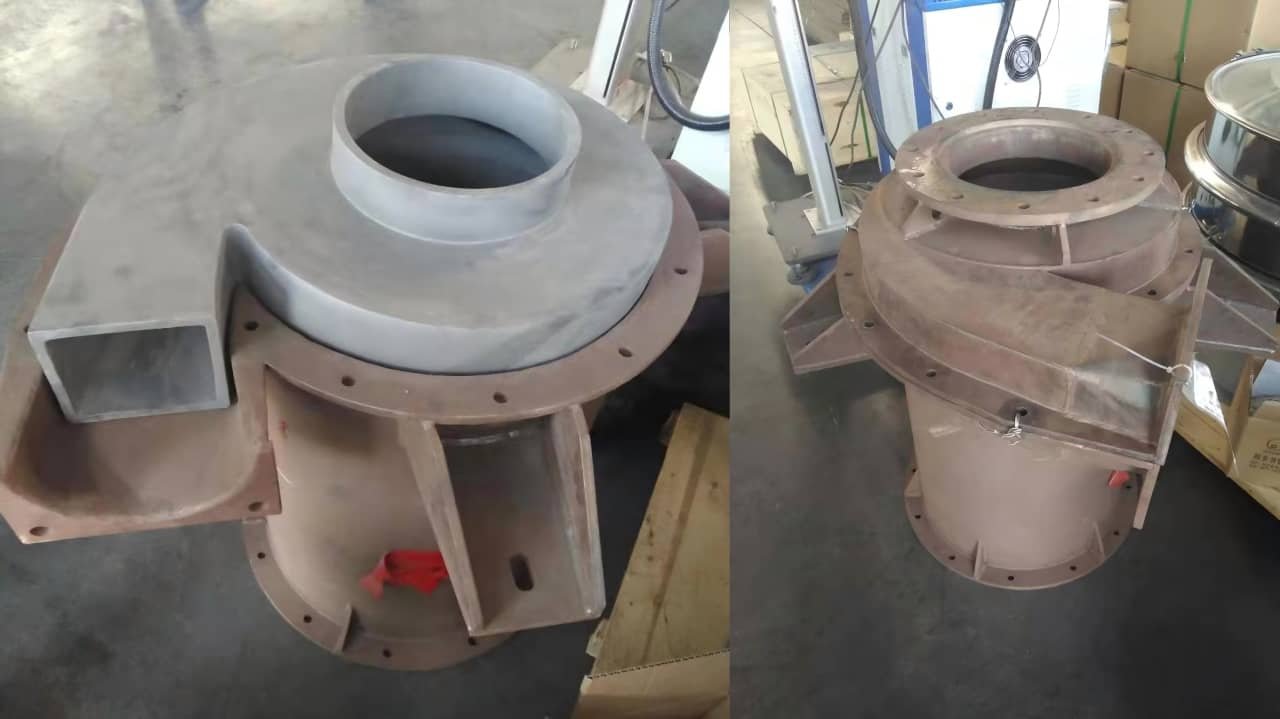 Silicon Carbide Cyclone Lining Application
FAQs
Which liner material has the longest service life in industrial slurry processing?
Silicon carbide ceramic liners. Their wear resistance far exceeds steel and rubber liners to resist particle scouring and medium corrosion stably.
Can rubber liners work in high-temperature production environments?
No. Conventional industrial rubber liners fail above 80℃. High temperature causes aging, hardening and peeling.
Is the high cost of silicon carbide liners worth investing in?
Yes, especially for harsh working conditions. Their ultra-long service life reduces replacement frequency and downtime losses. They bring lower comprehensive operating costs than steel and rubber liners in long-term operation.
Which liner is best for noise reduction in production workshops?
Rubber liners are the top choice. Their flexible structure buffers material impact effectively. They greatly reduce equipment running noise and vibration.
Do steel liners need regular anti-corrosion maintenance?
Yes. Steel liners rust easily in humid or corrosive environments. You need regular anti-rust painting and inspection to extend their service life.
Can silicon carbide liners resist strong acid and alkali corrosion?
Yes. Silicon carbide ceramic materials have stable chemical properties. They resist most strong acid, strong alkali and organic solvent corrosion for long-term use.
Conclusion
Steel, rubber, and silicon carbide liners each have their unique application value in industrial production. A reasonable liner selection stabilizes production efficiency, cuts maintenance costs, and maximizes your equipment service life.
Are you finding suitable silicon carbide liners? Contact Newthink New Materials. With decades of experience in the advanced ceramic industry, we support customized liner solutions based on your needs.
Thanks for your reading. Hope this article will be helpful.


 Portuguese
  English
  Spanish
  German
  Arabic
