
Recrystallized silicon carbide provides excellent thermal stability with chemical corrosion resistance. RSiC crucibles are the ideal choice for high-temperature applications to bring consistent output. Nevertheless, even high-quality RSiC crucibles may face certain problems due to improper design and setup.
In this article, you will find the causes and solutions to those problems through a practical case of RSiC crucible failure.
What is an RSiC Crucible?
Let’s get a briefly review RSiC before examining the case study.
Read More: What is a Ceramic Crucible?
Properties of RSiC Crucibles
RSiC is a highly pure ceramic that has been made using very high sintering temperatures. The material remains mechanically strong even at 1,600℃ or higher temperatures, and also withstands thermal shock and chemical attacks by most molten industrial materials.
These make it ideal for long, continuous high-temperature production runs.
Key Industrial Applications
RSiC crucibles are normally used in quartz powder lines. They are also extensively used in ceramic sintering and powder metallurgy processes.
Many users upgrade to RSiC from standard SiC for longer service life.
Real Case: RSiC Crucible Damage During Quartz Curing
We recently supported a client who faced unexpected crucible failure after first use. Their experience illustrates 2 frequent issues you may also face in your operations.
Operating Conditions
The client tested a new RSiC crucible for quartz powder curing treatment. Their furnace operated at a target temperature of 1,600℃ per batch. Heating and cooling rates were set between 2 and 3℃ per minute. Peak temperature was held for 2 to 3 hours for each processing cycle.
Observed Damage After the First Run
When the client opened the furnace after the weekend run, they found 2 problems.
- The crucible bottom had fully separated from the sidewall structure.
- Noticeable blistering appeared on the outer sidewall surface.
They had used other types of SiC crucibles for years without similar issues.
The client reached out to investigate potential manufacturing defects. They also wanted to know if specific furnace conditions caused the damage.

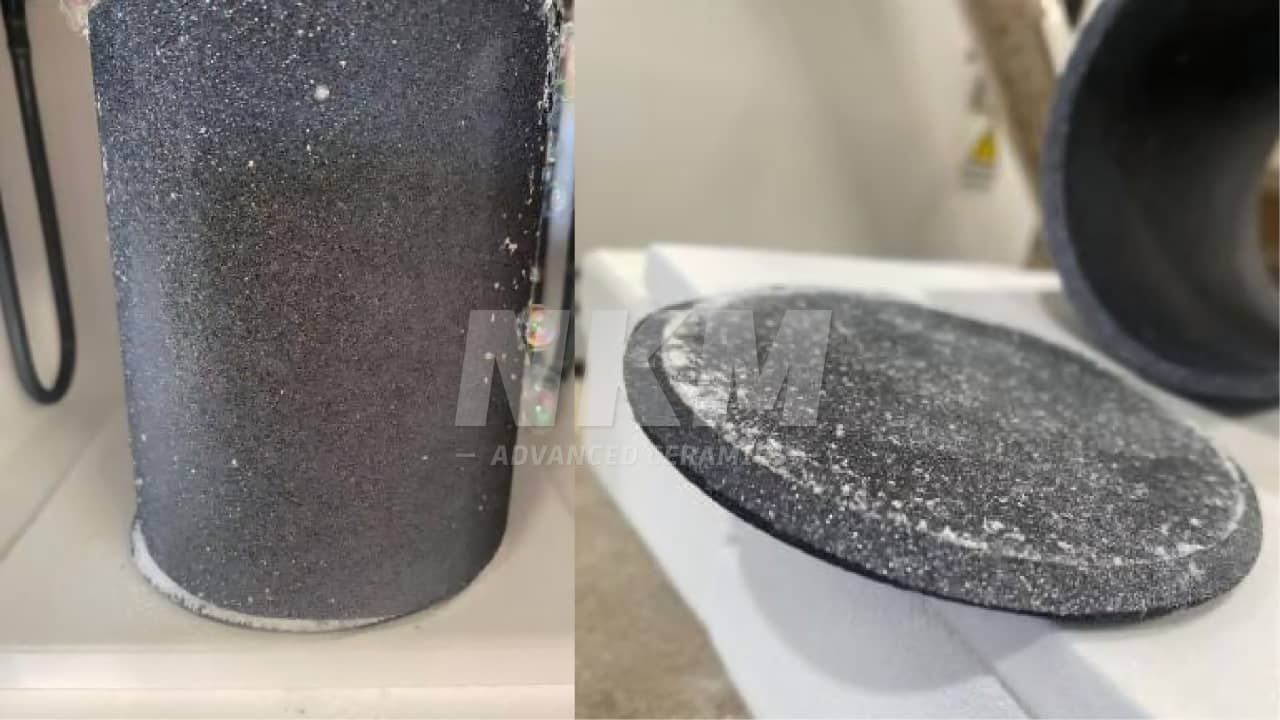 The Client Provided Photos Showing Separation at the Bottom of the Crucible
Cause Analysis of Crucible Issues
Our technical team reviewed the photos and furnace setup details. We ruled out manufacturing flaws and identified clear operational causes.
Outer Surface Blistering Near Heating Elements
The blisters were concentrated in areas close to silicon molybdenum heating rods.
Silicon molybdenum rods generate intense, highly localized heat during operation. When a crucible sits too near these rods, surface temperatures rise unevenly. This localized overheating triggers blister formation on the crucible exterior.
It is noticed that such blistering does not influence their structural integrity. The crucible is still functional, but blistering can shorten its overall service life.
Crucible Bottom and Sidewall Separation
First, it should be clarified that high-quality RSiC crucibles are integrally formed, not assembled from parts. They are sintered as a single piece, with no bonded seam between base and sidewall. So separation is not caused by weak adhesive or poor joint manufacturing.
The actual cause is uneven thermal expansion across the crucible body. The crucible bottom was in full, tight contact with the furnace base plate. This tight contact trapped heat and slowed dissipation from the bottom surface.
The sidewall, by contrast, heated and cooled at a very different rate. The resulting thermal stress caused the bottom to pull away from the sidewall. This specific failure mode was a first observation for our technical team.
Practical Solutions and Usage Optimization Tips
Based on our analysis, we recommended targeted fixes for the client.
Adjust Crucible Position
The simplest fix for surface blistering is to reposition your crucible.
Move it farther away from the furnace’s silicon molybdenum heating rods. This reduces localized overheating and prevents blister formation.
If furnace space is limited, you can add a lightweight heat shield instead.
Add Alumina Spacers
To fix uneven heat dissipation at the base, add small support spacers.
For example, use three corundum (alumina) spacers, each about 30mm in diameter. Place them evenly under the crucible to create a narrow air gap.
This gap allows heat to escape freely from the entire bottom surface. Even heat distribution eliminates the thermal stress that causes separation.
The client tested this fix in their next run without further damage reported.
Solutions to Extend RSiC Crucible Service Life
Besides these 2 problems, most of the failure patterns have targeted, field-verified solutions. You can implement these measures in your production line with minimal extra cost.
Optimize Thermal Cycle Control
Follow a reasonable staged heating curve for cold or brand-new crucibles.
Below 800℃, keep the heating rate at 100-120℃ per hour.
Between 800℃ and 1,400℃, you can increase the rate to 150-200℃ per hour.
Slow down again above 1,400℃.
For cooling, let the crucible cool down with the furnace above 1,000℃. Never use forced air cooling or water quenching on hot crucibles.[1]
Standardize Loading & Operation
Preheat solid raw materials before adding them to a hot crucible. Use dedicated tools to lower materials gently.
Do not drop heavy charge from a height, as this causes impact damage and hidden microcracks.
Keep charge volume below 80% of the crucible inner height to prevent overflow.
Distribute heavy materials evenly across the bottom to avoid local stress concentration.
Add Protection For Corrosive Applications
For processes with fluoride or alkaline materials, apply a high-purity boron nitride coating on the inner wall. The coating creates a dense isolation layer between the melt and the SiC substrate.
For highly corrosive conditions, you can also use a matching ceramic liner to protect the RSiC crucible body.
Establish Regular Inspection And Maintenance Routines
Inspect the crucible for surface cracks, corrosion spots, and deformation before each production run. Measure wall thickness at 3-4 key points every month to track wear rate.[2]
Store unused crucibles in a dry, ventilated area. Dry damp crucibles slowly at 100-200℃ for 4–6 hours before use.[1]
Use soft lifting clamps for handling to avoid edge chipping.
FAQs
Are recrystallized silicon carbide crucibles made as one single piece?
Yes. They are not glued or bonded from separate base and sidewall components.
Will surface blistering make my RSiC crucible unsafe to operate?
Surface blistering from localized heat does not damage internal structure. It is safe for continued use but may reduce long-term service life.
What is the maximum safe operating temperature for an RSiC crucible?
Most standard RSiC crucibles perform reliably up to 1,650℃ in air environments. Always refer to your product specification for exact temperature limits.
Can I use any hard material as a spacer under my SiC crucible?
No. Only use high-temperature materials like alumina (corundum) or SiC. Lower-grade materials may melt, react, or contaminate your process at high temperatures.
How can I tell if crucible damage is a manufacturing defect?
Manufacturing defects typically appear as pre-existing cracks or flaws before first use. Damage after heating cycles almost always links to operating conditions.
Can I repair an RSiC crucible that has separated at the bottom?
Bottom separation is structural damage that cannot reliably repaired. Replace the crucible and adjust your furnace setup to prevent future issues.
Conclusion
Most unexpected failures result from setup choices, not manufacturing defects. The case we shared shows how small adjustments can prevent costly production downtime.
If you face challenges with your RSiC crucibles, Newthink technical team can assist you. We dedicate to silicon carbide ceramics since 2011, providing tailored guidance to match your specific furnace and process requirements. Contact us for more info about customized RSiC crucibles and their maintenance.
Thanks for your reading. Hope this article will be helpful.


 English
 Spanish
 Portuguese
 German
 Arabic

