
In high-temperature thermal processes, the furnace tube defines your process limits. It shapes temperature uniformity, contamination control, and long-term operating costs.
Two materials dominate industrial furnace tube applications: silicon carbide (SiC) ceramics and high-purity fused quartz. This article will analyze them across all important dimensions, helping you learn exactly where each material excels and how to match the right tube to your process requirements.
What is a Silicon Carbide Furnace Tube?
Silicon carbide furnace tubes serve as process chambers for diffusion, oxidation, annealing, and sintering operations. They are high-performance components for extreme thermal environments.
Based on production technique, SiC tubes come in several grades. The most common types are reaction-bonded SiC, sintered SiC and recrystallized SiC.
Key Properties of SiC Furnace Tubes
- Ultra-high-temperature resistance:Stable up to 1,600℃ in an inert gas, 1,300℃ in air.
- Exceptional thermal conductivity: 100-200 W/m·K, roughly 100 times higher than quartz.
- Excellent chemical resistance: Withstand most acids, alkalis, and corrosive process gases.
- High mechanical strength:Maintain structures under heavy thermal and mechanical loads.
- Low devitrification risk: Do not soften or sag at standard process temperatures.

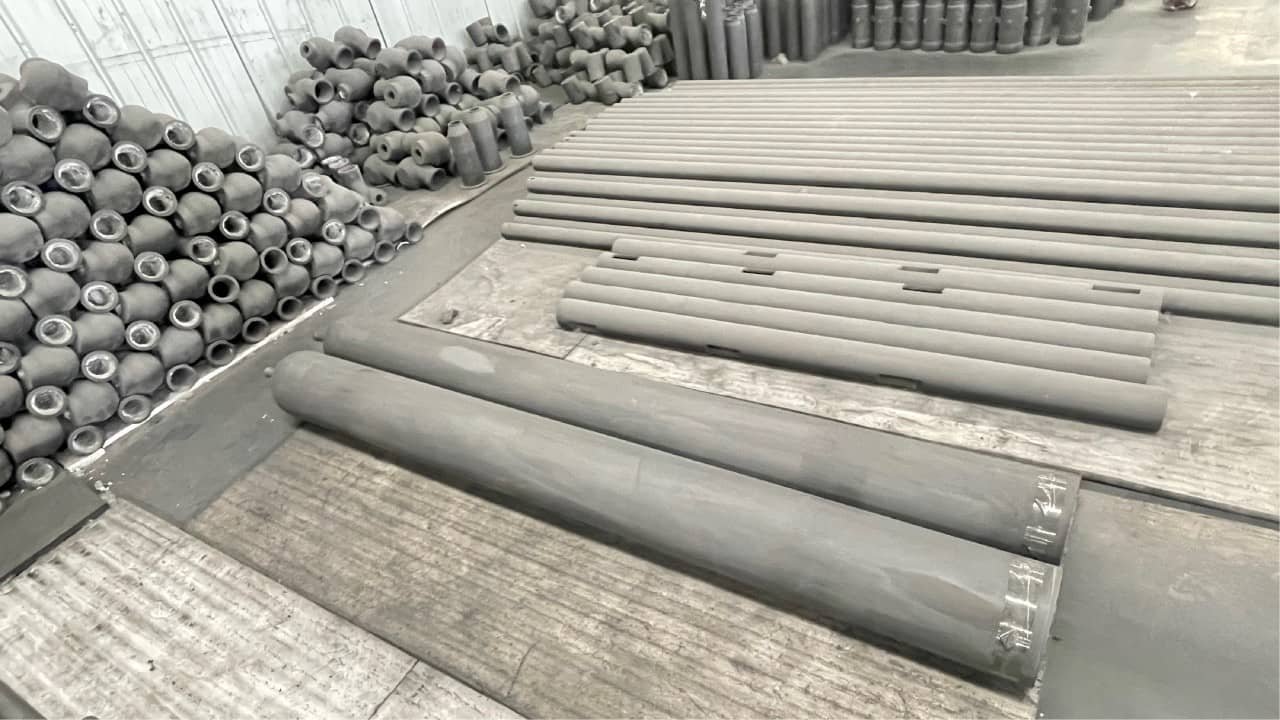 Silicon Carbide Furnace Tubes
What is a High-Purity Quartz Furnace Tube?
High-purity quartz furnace tubes have served as the standard process chamber in semiconductor manufacturing for decades. They are made from fused synthetic or natural silica (SiO2).
Quartz tubes are classified by their impurity levels. Standard semiconductor grade contains ≤20 ppm total metallic impurities. Ultra-high-purity grades reduce this to ≤5 ppm, with alkali metals controlled below 1 ppm.
The material is amorphous silica formed by melting high-purity quartz sand at extreme temperatures. This structure gives quartz its unique combination of thermal and optical properties.
Key Properties of Quartz Furnace Tubes
- Extreme chemical purity: 99%+ SiO2 content with ppb-level trace metal control.
- Ultra-low thermal expansion: 55×10-6/℃. It is the lowest of any common furnace tube material.
- Excellent thermal shock resistance:Survive rapid temperature swings without cracking.
- Optical transparency: Support visual process monitoring and radiant heating systems.
- Proven contamination control:Prevent metal ion diffusion into wafers and substrates.

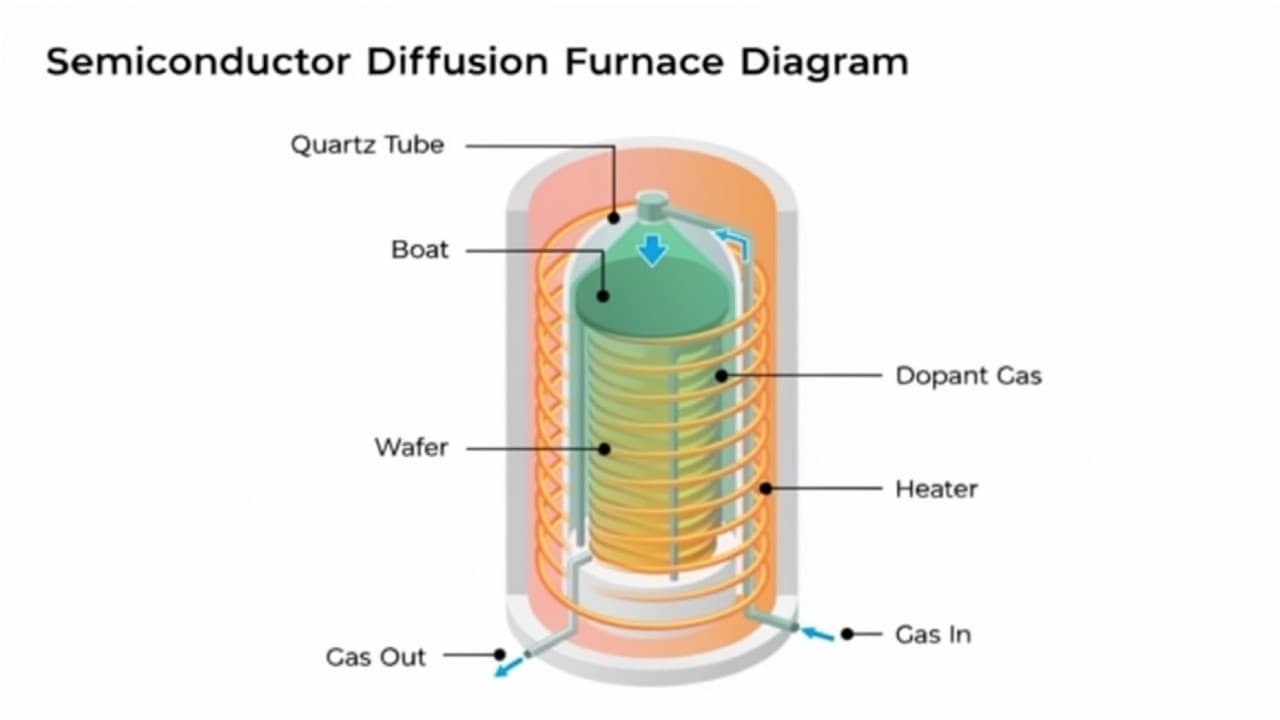 Quartz Furnace Tube Used in Semiconductor Applications
Comparison: SiC vs Quartz Furnace Tubes
Confused about how to choose? Now we compare the two materials across 7 performance categories to help you identify the best match for your specific application.
Highest Operating Temperature
Temperature capability directly determines which processes your equipment can run.
Silicon carbide tubes handle significantly higher temperatures than quartz. Standard SiC grades operate continuously at 1,300℃ in oxidizing atmospheres and up to 1,600℃ in inert or reducing environments. Some specialized grades push even higher.
Quartz tubes have a maximum continuous operating temperature of 1,100℃. They can withstand brief exposure to 1,200℃ but begin to soften and deform above that threshold. Prolonged operation at elevated temperatures causes sagging and devitrification.
Overall, silicon carbide possesses nearly 200-500℃ higher temperature capability.
Thermal Conductivity
Thermal conductivity determines how well heat distributes across the tube wall. Temperature uniformity inside the furnace directly impacts product quality and process yield.
SiC tubes deliver thermal conductivity of 100-200 W/m·K at operating temperatures. Such high conductivity eliminates hot spots and creates a uniform thermal profile throughout the process zone.
Quartz tubes have very low thermal conductivity, around 1.4 W/m·K. This will create larger temperature gradients and longer heat-up times. You need careful heating element design to compensate for quartz’s insulating properties.
Thermal Shock Resistance
Quartz has an extremely low coefficient of thermal expansion at 0.55×10⁻⁶/℃. This means it hardly changes size when heated or cooled. In fact, a quartz furnace tube can withstand quenching from 1,000℃ directly into room-temperature water without cracking.
Silicon carbide has a higher expansion coefficient of approximately 4.0×10⁻⁶/℃. This number is still low compared to metals. However, it still creates more thermal stress during rapid temperature changes.
SiC handles thermal shock well but not as exceptionally as quartz.
Chemical Resistance Performance
Process gases and atmospheres attack furnace tubes over time.
Silicon carbide provides excellent resistance to most acids, alkalis and corrosive gases. It remains unaffected by most process chemistries up to 800℃. At higher temperatures in air, a protective silica layer forms on the surface, preventing further oxidation.
Quartz has good resistance to most acidic conditions. But it is vulnerable to strong alkalis and hydrofluoric acid, and reacts with phosphorus and boron dopants at very high concentrations over extended periods.
Silicon carbide has a broader chemical resistance, especially at elevated temperatures.
Mechanical Strength
SiC tubes have superior flexural strength and hardness. They maintain nearly the best mechanical strength up to 1,600℃ with no degradation. This makes them resistant to impact, abrasion, and structural loading.
Quartz is inherently brittle and fragile. It chips and cracks easily if dropped or mishandled during installation or maintenance. Besides, its mechanical strength decreases significantly as temperature approaches the softening point.
Service Life & Cost
Silicon carbide tubes typically last 24-36 months under common operating conditions, even exceeding five years. Their resistance to degradation means fewer replacements and less production downtime.
Quartz furnace tubes generally last 6-12 months in production environments. Due to devitrification, sagging, or contamination buildup, they usually retire after 200-500 thermal cycles. Frequent replacement also increases labor costs, and lost production time.
Purity & Contamination
For semiconductor and other ultra-clean processes, even a little impurity can ruin product yields.
High-purity quartz sets the standard for cleanliness. With 99.99%+ SiO₂ and ppb-level metallic impurities, it introduces virtually no contamination. It does not leach metal ions into the process atmosphere even at high temperatures.
Silicon carbide tubes are available in various purity grades. Standard industrial grades contain trace impurities from sintering aids. Although CVD and high-purity sintered grades approach quartz-level purity, they cost more.
SiC or Quartz Furnace Tubes: Which One Should You Choose?
Now that you understand the basic performance differences between these two materials. How to make a quick choice? Below, we’ve listed some applications where silicon carbide furnace tubes and quartz furnace tubes are suitable, respectively. The right choice depends entirely on your process parameters, quality requirements, and budget constraints.
When to Choose Silicon Carbide Furnace Tubes?
SiC is the clear choice for any application that pushes beyond quartz’s temperature limits.
You should strongly consider silicon carbide if:
- Your process runs above 1,100℃ on a continuous basis.
- You need rapid thermal cycling with fast ramp rates.
- Your process involves corrosive gases or aggressive atmospheres.
- You want to reduce maintenance frequency and production downtime.
- You process heavy loads that create mechanical stress on the tube.
- You operate sintering furnaces for advanced ceramics or powder metallurgy.
When to Choose High-Purity Quartz Furnace Tubes?
Quartz is still the best solution for moderate-temperature, high-purity processes.
Stick with quartz furnace tubes if:
- Your process runs at or below 1100℃ continuously.
- You manufacture semiconductors with strict contamination requirements.
- You need optical access for process monitoring or radiant heating.
- Your process involves extreme thermal shock conditions.
- You have budget constraints for initial capital expenditure.
- You run standard diffusion, oxidation, or LPCVD processes.
- Dimensional stability during thermal cycling is critical to alignment.
FAQs
Can I replace a quartz tube with a SiC tube in my existing furnace?
In most cases, yes, but you must verify temperature ratings and flange compatibility. Always consult your furnace manufacturer before making the switch.
How do I clean and maintain SiC furnace tubes properly?
You can clean SiC tubes with mild acid solutions or grit blasting for heavy deposits. Avoid hydrofluoric acid. Inspect regularly for surface oxidation and structural cracks.
What causes quartz tube devitrification?
Devitrification occurs when amorphous quartz recrystallizes at high temperatures. Contamination from alkali metals, fingerprints, or process residues accelerates this process. It causes clouding, brittleness, and eventual tube failure.
Are there size limitations for SiC furnace tubes?
SiC tubes are available in diameters from a few millimeters up to 300mm or more. Lengths can exceed 2000mm depending on the manufacturing process. Very large diameters may have wall thickness limitations. Custom sizes are available from most ceramic component suppliers.
Which material is better for vacuum furnace applications?
Silicon carbide. Quartz can outgas at very high temperatures and low pressures. For vacuum processes below 1,000℃, both materials work well. Above that range, SiC is the preferred choice.
How do I calculate total cost of ownership for furnace tubes?
Add purchase price, installation labor, replacement frequency, and estimated downtime costs. Divide by expected service life to get cost per operating month.
Can SiC tubes be repaired if damaged?
Minor surface damage can sometimes be repaired with SiC paste or coatings. Structural cracks generally cannot be repaired reliably.
Conclusion
Choosing between silicon carbide and high-purity quartz furnace tubes comes down to matching material properties to your process needs. The key is understanding your specific requirements and selecting accordingly.
If you are still confused about how to choose, you can contact Newthink New Materials. We provide high-quality customized silicon carbide furnace tubes for industrial applications.
Thanks for reading. Hope this article will be helpful.


 English
 Spanish
 Portuguese
 German
 Arabic

