
Working in industries like electronics, semiconductors or aerospace, you probably understand how equipment’s thermal management efficiency can affect the performance of your products. Finding the right ceramic material can drastically bring down equipment failure rates and prolong its service life. This article will introduce ten such ceramics with high thermal conductivity and provide you with the references to choose.

 Ceramic Products Made of Different Materials
10 High Thermal Conductivity Ceramic Materials
Polycrystalline Diamond (PCD)
Thermal Conductivity: 1642–2000 W/m·K
Properties: PCD is one of the best thermal conductors. Its performance depends on the preparation method used and the level of impurities.
Applications: PCD can be used in places where highly effective heat dissipation is required. Because of its excellent thermal conductivity and wear resistance, it is now used in modern industry as high-wear parts and cutting tools. Its high-temperature and high-conductivity properties are leveraged in the manufacture of high-temperature or high-conductivity components. PCD’s excellent heat dissipation capabilities make it a promising solution for electronic device cooling and precision instruments.
Beryllium Oxide (BeO)
Thermal Conductivity: 260–300 W/m·K
Properties: BeO’s thermal conductivity is 10 times than that of alumina ceramics. It also has excellent insulation properties and good resistance to thermal shock.
Applications: With its high thermal conductivity and good insulation property, BeO can be used in power device packaging as a high-conductivity substrate in the electronics industry. In aerospace, its resistance to thermal shock can be utilized in aircraft and satellite communication system components. Other applications include nuclear power, linings of automotive ignition devices, and in the laser industry for the production of high-efficiency lasers.
BeO powder is highly toxic, and its thermal conductivity decreases considerably with the temperature rise. As a result, the applications of BeO are quite limited. Strict control over usage processes is needed.
Aluminum Nitride (AlN)
Thermal Conductivity: 170–320 W/m·K
Properties: High thermal conductivity and excellent insulation. The thermal expansion coefficient is compatible with that of silicon.
Applications: The main applications of AlN are in electronic and semiconductor packaging, which include but are not limited to heat dissipation substrates for high-power modules and electrostatic chucks. In aerospace, the metal’s resistance to high temperature allows its application in parts related to the engine and other components at elevated temperatures. It serves the new energy automobile industry in making heat dissipation modules. Being non-toxic and environment-friendly, AlN can be used as a filler in thermal interface materials, overcoming the toxicity problem of BeO.
Hexagonal Boron Nitride (h-BN)

 Boron Nitride Products (Tubes) Manufactured by NKM
Thermal Conductivity: 185–300 W/m·K
Properties: A versatile material with outstanding thermal conductivity. It also has good high-temperature resistance, chemical corrosion resistance and insulation.
Applications: h-BN is widely used in industries that involve very high temperatures and in metallurgy. The extreme thermal conductivity and insulation properties of h-BN make it suitable for use in heat dissipation substrates and high-frequency insulation materials in the electronic and semiconductor industries. The high resistance to temperature is utilized to produce high-temperature lubricants and thermal protection materials in aerospace. In the chemical industry, it is used in the manufacture of corrosion-resistant equipment.
NKM offers boron nitride products, including hexagonal boron nitride. For more information about boron nitride products, please visit Boron Nitride Ceramic.
Silicon Carbide (SiC)
Thermal Conductivity: 90–270 W/m·K
Properties: Silicon carbide maintains good performance in heat dissipation at high temperatures. The heat conductivity decreases with increasing temperature. It is very hard and resistant to wear.
Applications: SiC is the best material to balance high-temperature stability and heat dissipation efficiency. It is used in semiconductor manufacturing and the photovoltaic sector for producing photolithography machine components, wafer processing parts, and epitaxial trays because of its excellent high-temperature stability and abrasion resistance. In high-temperature industries, it serves as kiln furniture, while in the chemical and metallurgical sectors, SiC is used to make corrosion-resistant parts, wear-resistant components, and heat exchangers. Furthermore, it can be applied in the military sector to the enhancement of protection systems and improvement of bulletproof armor quality. It could also be prepared for the manufacture of heat dissipation substrates in new energy and power electronics.

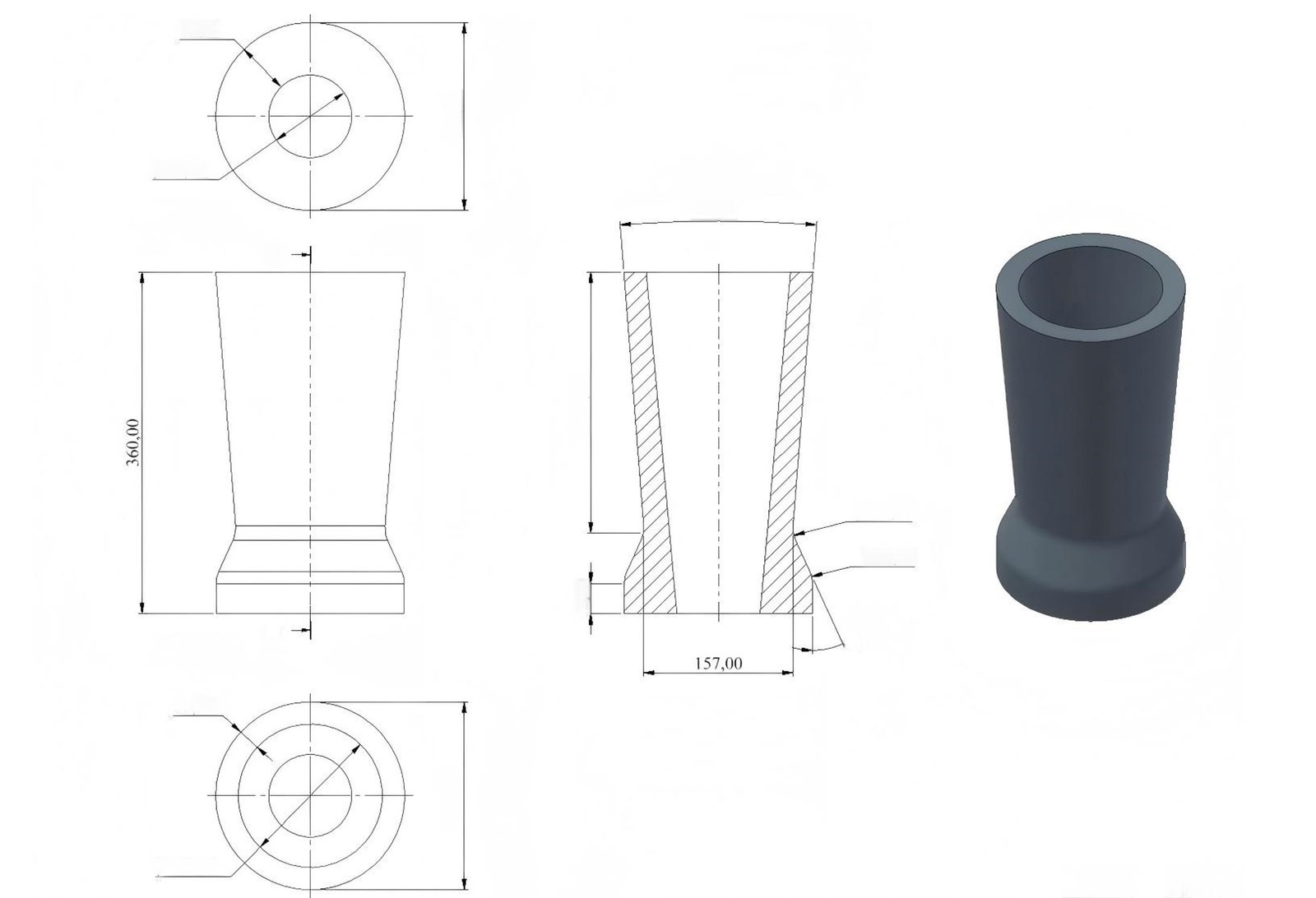 NKM Customer-Customized Silicon Carbide Bushing Drawings
Case: Silicon Carbide Ceramic Crucibles
Silicon carbide crucible is used to melt metals like aluminum, copper and zinc. It has excellent thermal conductivity, allowing a large reduction in the melting time. This saves energy and also improves efficiency. Compared to alumina one, the thermal conductivity of silicon carbide crucible is 3-5 times higher, assuring faster and more homogeneous heat transfer.
Silicon Nitride (Si3N4)
Thermal Conductivity: 85–177 W/m·K
Properties: High thermal conductivity with excellent thermal shock resistance. It has high mechanical strength with superior fracture toughness as compared to conventional ceramics.
Applications: Silicon nitride is used for both comprehensive mechanical properties and heat dissipation. In the field of machinery, it is utilized in the production of ceramic bearings, cutting tools, and industrial components because of its very high strength and resistance to wear. In the semiconductor industry, Si3N4 is utilized to manufacture substrates and components of processes due to its thermal conductivity and stability. For its biocompatibility, silicon nitride is also used in the bioceramic sector to make medical implants.
Case: Silicon Nitride Ceramic Substrate
Silicon nitride ceramic substrates serve for heat dissipation for high-power LED chips. The low thermal expansion coefficient of silicon nitride aligns with that of silicon chip materials, thereby prolonging device lifespan. Substituting traditional alumina with silicon nitride substrates greatly increases the efficiency of heat dissipation by more than 3 times. Silicon nitride one also withstands high-frequency thermal cycles.
Titanium Diboride (TiB2)
Thermal Conductivity: 50–100 W/m·K
Properties: High hardness, high melting point, and electrical conductivity.
Applications: TiB2 has excellent electrical conductivity and wear resistance. The primary application is as a cathode coating in the aluminum electrolysis industry. It finds applications in vacuum coating due to its electrical conduction and resistance to high temperature for providing conductive evaporation boats. It is also utilized in the production of wear-resistant and corrosion-resistant components. Titanium diboride has great potential in such applications that demand both electrical conductivity and heat dissipation, such as electrolytic equipment.
Magnesium Oxide (MgO)
Thermal Conductivity: 30–60 W/m·K
Properties: Highly insulating with a high melting point, highly chemically stable.
Applications: Traditionally, MgO is used as an auxiliary material in many industries like steelmaking, metallurgy and rubber. Because of its unique physical properties, nanomagnesium oxide has a wide application in some emerging fields, such as new sterilization materials, radar-absorbing materials in defense, additives and nanoceramics. Magnesium oxide is particularly suitable for medium or low-temperature industrial situations that need high insulation and good chemical stability.
Alumina (Al2O3)

 NKM’s Alumina Product Production Workshop
Thermal Conductivity: 25–37 W/m·K
Properties: The higher the purity, the higher the thermal conductivity. It has a low production cost, mature preparation process, and is capable of mass production.
Applications: Alumina ceramics are the most widely used and inexpensive basic high-conductivity ceramic materials. They are used for semiconductor device components and electronic parts. In industrial machinery, they are mainly used as wear-resistant parts, while in high-temperature fields, they are used as refractory and insulating materials. In the chemical and metallurgical sectors, alumina’s corrosion resistance makes it ideal for the manufacture of anti-corrosion equipment.
Case: Alumina Electrostatic Chucks
The thermal conductivity of 99.8% high purity alumina is about 30 W/(m·K). Electrostatic chucks made of it are employed in etching and ion implantation machines. While holding the wafer in place, they dissipate heat to maintain temperature stability. In the photolithography machines and transfer systems, thermal conductivity by the alumina parts prevents local overheating that can cause deformation of the wafers.
Zirconia (ZrO2)
Thermal Conductivity: 2.5–3 W/m·K
Properties: Extremely low thermal conductivity. It has high toughness and strength. Its unique advantage is excellent biocompatibility.
Applications: Zirconia ceramics can be used for those applications that call for both thermal insulation and structural strength. In structural ceramics, the high strength and toughness are utilized for the manufacturing of grinding media, mechanical parts, and tools. Because of its excellent biocompatibility, zirconia finds its applications in the medical and dental fields to produce dental crowns and implants.
Case: Zirconia Plunger
Within the chemical industries, metering applications take advantage of zirconia plunger pumps. The low thermal conductivity of zirconia makes sure that friction heat does not quickly distribute within the component and, therefore, prevents localized overheating and seizing. Simultaneously, its high wear resistance ensures a long service life.
How to Choose Materials to Suit My Industrial Manufacturing?
Because of varying equipment conditions and different performance requirements, different industries require different kinds of ceramics. Based on 14 years of industrial experience, we recommend the choice of appropriate materials for the following advice:
The most preferred materials are AlN and SiC for the electronics and semiconductor industries. These meet the demanding requirements of high power, such as that used by IGBT modules and LED chips with high thermal conductivity, high insulation, and a thermal expansion coefficient compatible with silicon substrates. Aluminum Nitride prevents cracking due to thermal expansion and contraction, while Silicon Carbide is used for extreme temperature conditions, such as in photolithography machines, which ensure reliable chip operation.

 Semiconductor Applications of SiC Ceramics
In the New Energy Industry, including but not limited to Electric Vehicles and Photovoltaics, the preferred choices are Si3N4 and SiC. The excellent thermal shock resistance of Silicon Nitride is well utilized in handling high temperatures and vibrations in automotive applications. Silicon Carbide, with its high-temperature and wear resistance, can prolong the service life of photovoltaic equipment, reducing maintenance costs.
The focus in the aerospace industry is on SiC and Si3N4. Silicon Carbide withstands the high-temperature airflow faced by an aircraft, while the wave transparency and thermal shock resistance of Silicon Nitride guarantee stability to antenna covers in complicated conditions.
In high-temperature and metallurgical industries, the best options are SiC and MgO. Silicon Carbide is able to bear the temperature above 1600℃ and resists corrosion by metals. Magnesium Oxide is chemically stable and doesn’t react with liquid metals. It also prevents electrical leakages in furnaces for production safety.
Would you like to know more about the customized high thermal conductivity ceramic solution? For the specific materials selection case in your industry, please contact Newthink New Material for a quotation. Our engineers will provide you with the highest quality products and service. Our products will meet your needs in production in electronics, new energy, aerospace, and other industrial fields.


